trust the craving
food noise, body cues, and the unexpected wisdom of a silent meal

Over the weekend, when picking up sandwiches at a local supermarket, I eyed a fluffy rice crispy treat and immediately snatched it up. One thing about me is I LOVE rice crispy treats. I wasn’t craving one when walking in the store, but after seeing it, I just couldn’t wait to enjoy its crunch and sweetness.
When waiting in line, a woman approached me and said, “is that a rice crispy treat?? That is MASSIVE.”
doing so helps ensure big feelings gets seen by more people, as does subscribing (whether paid or free) below.
And then no further commentary. She abruptly walked away.
At a different point in my life, perhaps I would have second guessed myself.
Is it too big? Should I put it back? Is there a smaller one? Should I get something else instead?
But I really wanted it!! So I got it, and after my sandwich, I eagerly took a few bites. I noticed all of the different textures, the way the taste changed with each crunch.
About half way through, a bell went off in my brain and body. I savored the square, and then I was satisfied, and offered the rest to Mike.
At different points in my life, this would have been an entirely different experience. I WOULD have put it back, trusting the unsolicited commentary of a stranger more than my own brain and body.
But oftentimes that second guessing leads to other behaviors.
Say I did put it back, leaving the craving unsatisfied.
Perhaps later in the day I would have chosen another sweet item, though would have been comparing it to the rice crispy. Maybe it wouldn’t have been as satisfying. That combination - depriving myself of the craving in the moment, paired with eating something less satisfying - may have led to eating more of the thing I wasn’t really satisfied by, simply because I’m trying to chase or capture the satisfaction that already fled earlier that day.
Or maybe I would have just continued to think about not just the rice crispy but sweets or food in general for the rest of the day. After all, whenever restriction is present, food noise will be LOUD.
The mentality of restriction and the thoughts that accompany it lead to real behavior changes.

So how to build this degree of discernment when it comes to food choices?
It’s especially challenging when existing in a world of near constant overstimulation or overwhelm.
Sometimes a sensory deprivation exercise can be helpful, and what immediately comes to mind is one of the activations offered during the metreat.

One meal was spent entirely in silence. When we entered into the area where the food was prepared, silence was encouraged. Truthfully, I wasn’t all that excited for it. I wanted to chat! To catch up with friends!
But it was incredibly enlightening.
Here are some things that revealed themselves to me during the silent meal:
Even if the meal doesn’t start mindful or silent, the ground can start to shake mid-way through. You can grow and sink into it. And in fact, what a normal thing it would be for it to unfold in that way. Much of our lives are spent in the productivity spiral, and it takes removing some layers in order to gradually descend into mindfulness. Set aside at least 20 minutes to see how things go, and then another 10 minutes for digestion.
You may be able to anticipate or respond to the needs of others more when talking is removed from the equation. In the silence or in the unspoken word; in just the body language. More eye contact is required. It was a nice reminder that connection isn’t always through speech. Nor does it always have to be stated or over-stated.
There is comfort and nourishment in lingering over a meal. In staying and sipping when not riveted or stimulated by conversation. Perhaps it allows deeper appreciation for the meal, thereby hearing hunger and fullness cues in a different way.
When finishing the meal, I was left with the question, “what does it mean to digest?” And how often we leave such little time for it. At work, I’m quickly eating while finishing patient notes or combing through my inbox. Here, there was nothing but time. To leave space for the in between and metabolize both the meal and the thoughts that bubbled up during it.
Digestion is meant to occur in the parasympathetic state. The rest and digest. That is nearly impossible when always in a rush. After the meal, I was comfortably full without feeling bloated or distended. I thoroughly enjoyed and savored.
I talk about mindful eating all the time at work. I even lead a mindful eating exercise during my group visit!
And sometimes it takes going back to basics and trying something again to feel reinvigorated by and reconnected to the experience.
When trying this, the environment matters.
Maybe it’s a day you prepped the ingredients beforehand (like I did with the recipe below). Maybe you set the table or light a candle.
Or you get take out. Or you make a dish that you know is a family favorite.
Doing a bit of prep work, and/or priming the environment, may permit a more easeful journey.
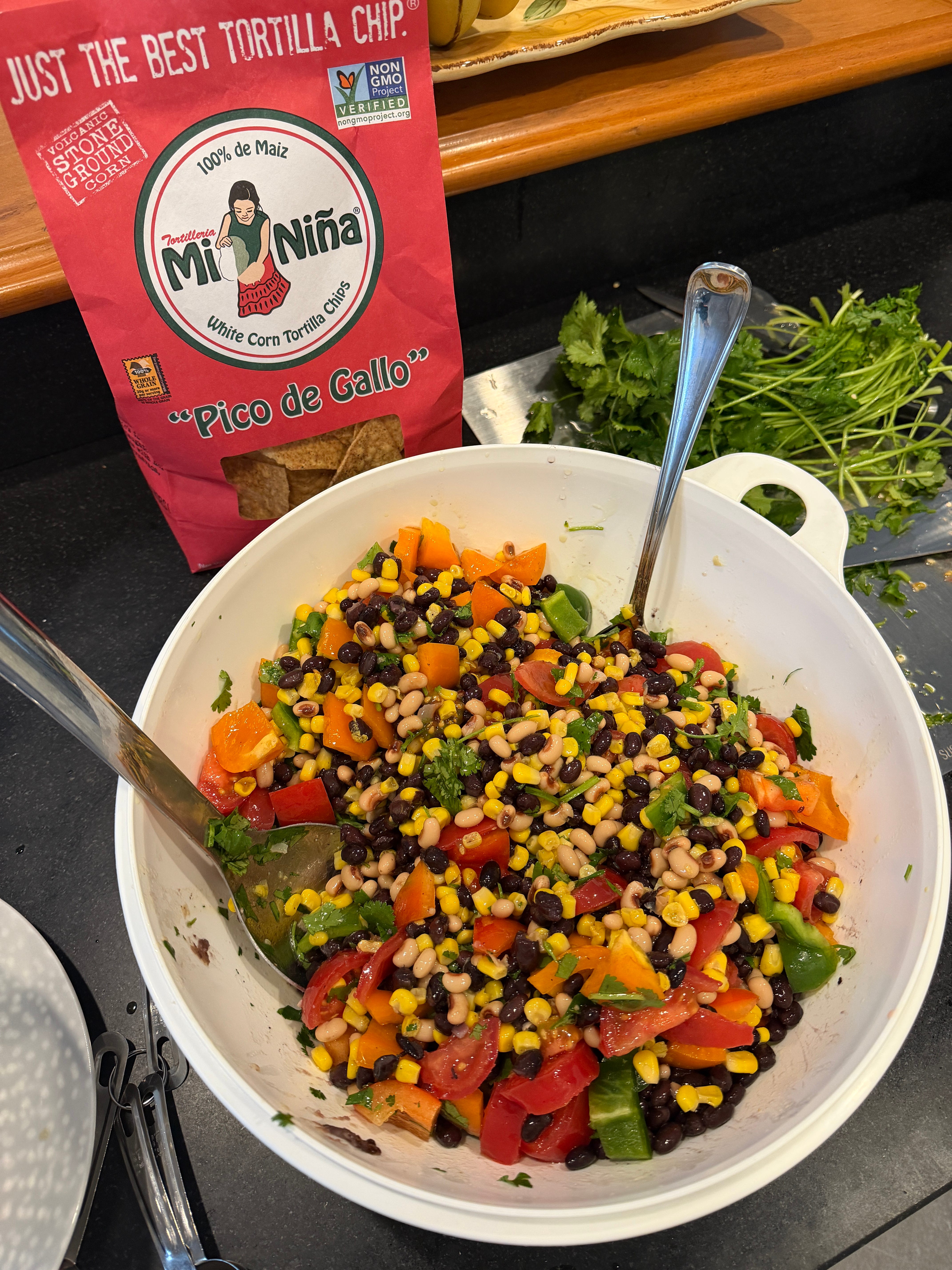
A staple in our household is this, slightly adapted from NYT cowboy caviar by Margaux Laskey. Mike has been making it since I’ve known him and it’s the best contribution to a holiday gathering.
I tripled the recipe to have all week long for meals and/or snacks.
FOR THE DRESSING
1 cup olive oil
3/4 cup red wine vinegar
3 to 4 garlic cloves, minced
salt and black pepper
FOR THE SALAD
7 plum tomatoes, diced
1 red onion, finely diced (about ¾ cup)
3 (15-ounce) can black beans, rinsed
3 (15-ounce) can black-eyed peas, rinsed
2 cans corn or 1 package frozen corn
3 bell peppers, seeded and chopped
1 cup chopped cilantro leaves
Mix separately, then pour dressing over salad and voila!!
Highly recommend pairing with the Mi Nina Pico de Gallo tortilla chips.